01 / UNDERSTAND
See the whole problem.
Look at the technology, the business setting and the likely consequences before choosing a direction.
We help businesses make sense of technology before they invest in it, build around it or ask teams to use it.
You do not have to know the right service name. Start with the situation that sounds familiar.
“We are considering a platform or tool and need to know whether it is worth it.”
Explore this path ↗“We have information everywhere but still argue about what it means.”
Explore this path ↗“We are publishing and spending, but struggle to connect activity to customers.”
Explore this path ↗“Our teams are moving the same information between too many tools.”
Explore this path ↗“Visitors arrive, but the website or platform does not help them move forward.”
Explore this path ↗“AI adoption is moving faster than our understanding of what the organisation can support.”
Explore this path ↗Most businesses already have plenty of tools. The harder part is knowing which problems deserve attention and which technology is actually worth the effort.
Which decision, capability, or outcome should technology improve?
What data, systems, dependencies, and constraints shape the solution?
What should be prioritized, tested, integrated, or deliberately avoided?
Look at the technology, the business setting and the likely consequences before choosing a direction.
Work out what is useful, what is risky and what the business is ready to support.
Shape a response that fits the problem rather than forcing the problem into a standard package.
Put the decision into practice, then learn from what happens.
A team can start using an AI tool in a day. Making it reliable, safe and useful across the business takes much more work.
Read the Xlantic Solutions perspective →Readiness, use cases, workflows, responsible adoption, and implementation realities.
Data quality, reporting, decision intelligence, measurement, and signal clarity.
Customer platforms, campaign systems, CRM, CDP, analytics, and integration.
Products, business systems, customer experiences, APIs, and operating workflows.
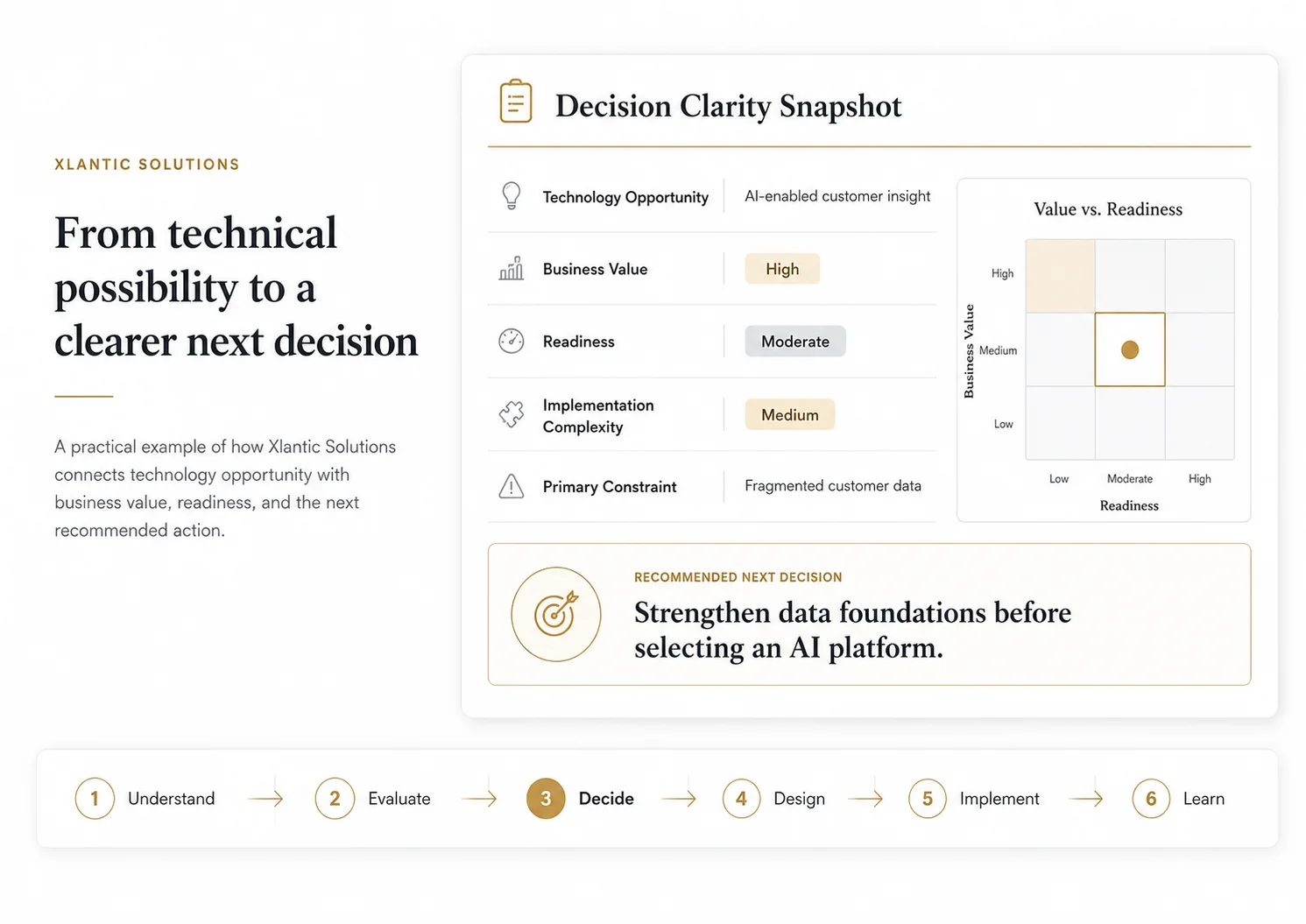
This example brings the opportunity, business value, readiness and next step into one view.
It helps people discuss the decision without getting lost in features or buzzwords.
Our public tools help people examine a difficult question and see what to do next.
Understand current AI reach, bottleneck risk, and opportunity spread.
Structure a difficult technology decision before investment or implementation.
Connect campaign performance, business context, and practical action.
Concise interpretations of technologies and the decisions they create.
Dashboards do not improve decisions merely by displaying more information. Their real value begins when they clarify what deserves attention.
A useful way to interpret the next infrastructure shift behind AI growth.
Understand → Evaluate → Decide → Design → Implement → Learn.