Compute is moving closer to available electricity.
AI infrastructure is beginning to treat power availability as a location decision. That may create new business models around distributed compute, energy orchestration, and regional infrastructure.
We look at accepted assumptions, new signals and patterns inside real businesses. The aim is to find a better question before the next decision is made.
Giving a team access to AI can happen in days. Making it dependable across data, work practices and accountability takes much longer.
The better question is whether AI is helping the business work better or simply adding another layer of activity.
Signals are brief notes on changes that may affect a business decision, a technology plan or the way customers behave.
AI infrastructure is beginning to treat power availability as a location decision. That may create new business models around distributed compute, energy orchestration, and regional infrastructure.
When platforms produce more metrics without a stronger decision structure, reporting becomes busier while signal clarity declines.
Organizations often add platforms faster than they simplify the connections between them. The visible toolset grows while the invisible operating burden grows with it.
A model is useful when it reveals what people are assuming and gives the discussion somewhere to go.
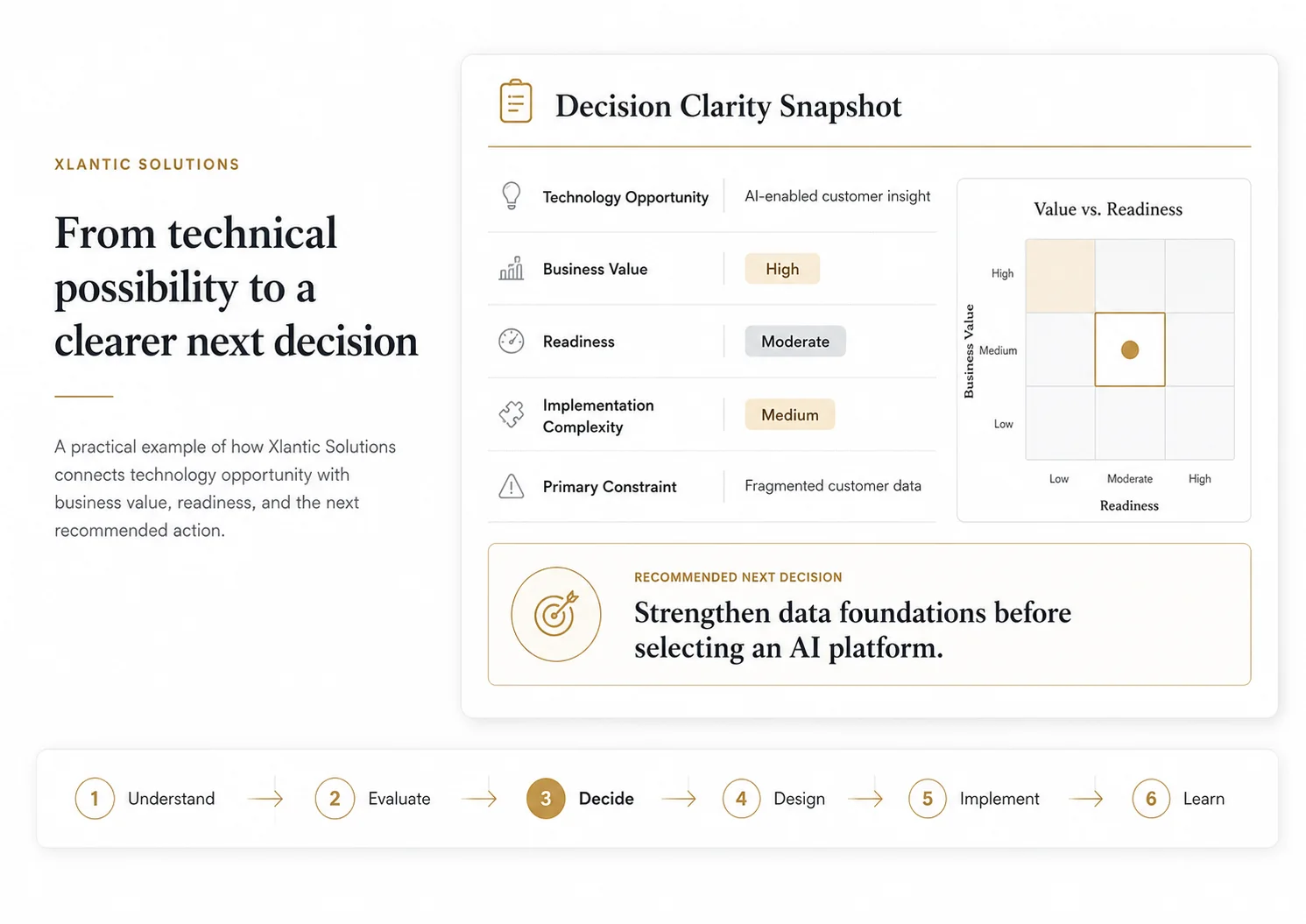
A decision can remain unclear even when plenty of information is available. The problem is often that value, readiness, cost and timing are being discussed in separate conversations.
The Decision Clarity Snapshot brings those factors together so leaders can judge both the opportunity and the business's ability to act on it.
The opportunity looks promising, but nobody is yet clear about what should happen first.

Separates metrics, events, and opinions from the few patterns that should influence action.
Evaluates technical possibility through business relevance, readiness, dependency, risk, and adaptability.
Field Notes capture the small gaps between what a system was meant to do and what people actually do with it.
Licences, logins, and training records do not reveal whether the tool has become part of how work is actually done.
The standard process may look efficient. Rework, escalation, approval loops, and manual corrections usually reveal the real friction.
A platform may have an IT owner, a business sponsor, and multiple users: but no one responsible for the outcome it was expected to improve.
The gap between the designed journey and the observed journey is where better digital experience decisions begin.
Notice a pattern or contradiction that keeps appearing.
Look at the assumption that makes the issue seem simpler than it is.
Place the technical facts beside the business context and the way people actually work.
Turn the observation into a question or next step that someone can use.